Know where your ingredients come from,
and where your supply is exposed.
Collect supplier origin declarations, review sourcing risks and map ingredient exposure in one place, with multilingual supplier workflows and annual updates.
For procurement, R&D and sustainability teams collecting origin information from their suppliers.
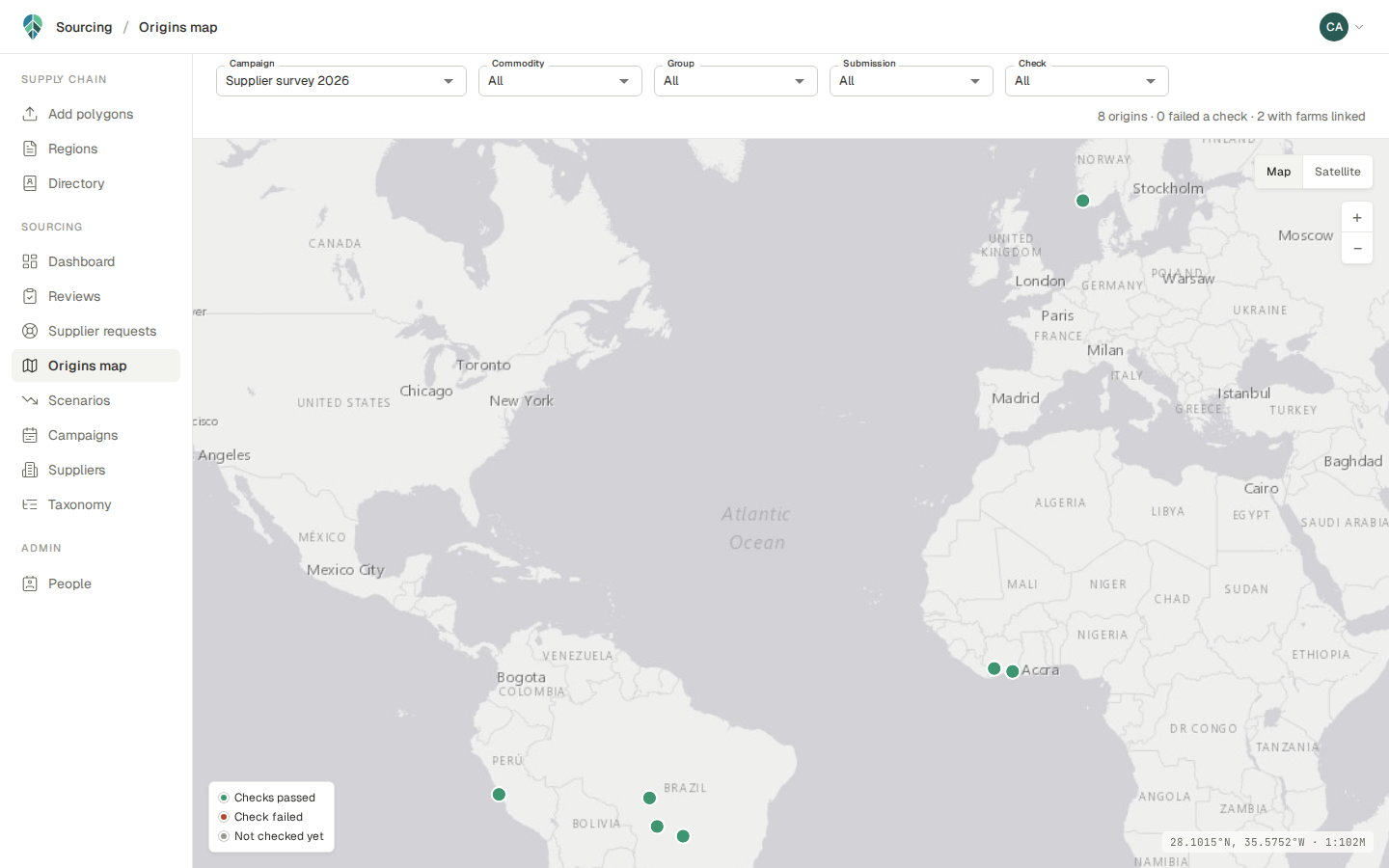
Material to farm and plot
Suppliers declare what each material is made of, where each ingredient comes from, and the farms and plots behind it.
Checks, then your approval
Location and overlap checks, satellite land-cover and deforestation flags, then your team's review and approval.
Exposure before disruption
See which ingredients and volumes are exposed if a country or supplier stops, and which other declared origins exist.
Annual sourcing-footprint mapping. Map supplier-declared ingredient origins and their share of each material's annual volume, with origin checks and recorded buyer approvals. This is origin-level mapping, not shipment- or batch-level tracking.
From the product you buy to the origins behind it.
A fat blend
A product you buy from one supplier, with its code and yearly volume.
Palm olein 70%, soybean oil 30%
What it is made of, in shares that add up to 100%.
A mill, a port or a growing area
Where each ingredient comes from, with its share of the year's volume.
The supply behind it
The cooperatives, farmers and plots behind each origin.
Suppliers answer in their own portal, in their own language. Each sees only its own materials. They upload plots as GeoJSON, KML, Shapefile or a spreadsheet.
Origins belong to the supplier's whole group, so a sister company can reuse them. Next year, approved answers carry forward and suppliers confirm only what changed.
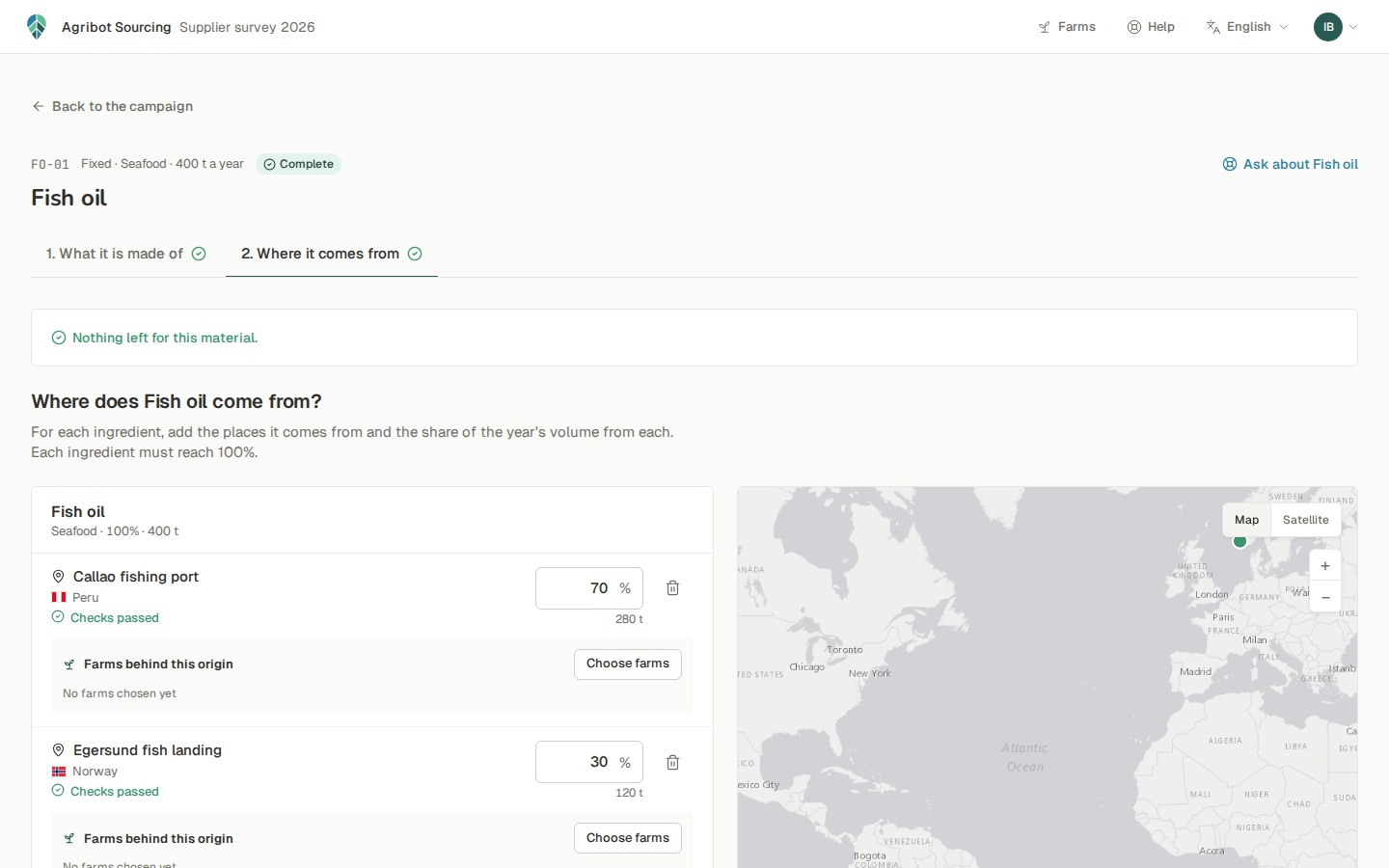
Check declared origins before approving them.
Geospatial checks
Check whether submitted plots fall within the declared country and flag overlaps for review.
Satellite-based checks
Land use, and possible deforestation after 31 December 2020, flagged for review.
Supplier evidence and your approval
Suppliers attach supporting documents, such as certificates. Your team reviews the evidence and check findings, requests corrections and records approvals, with a history of who did what and when.
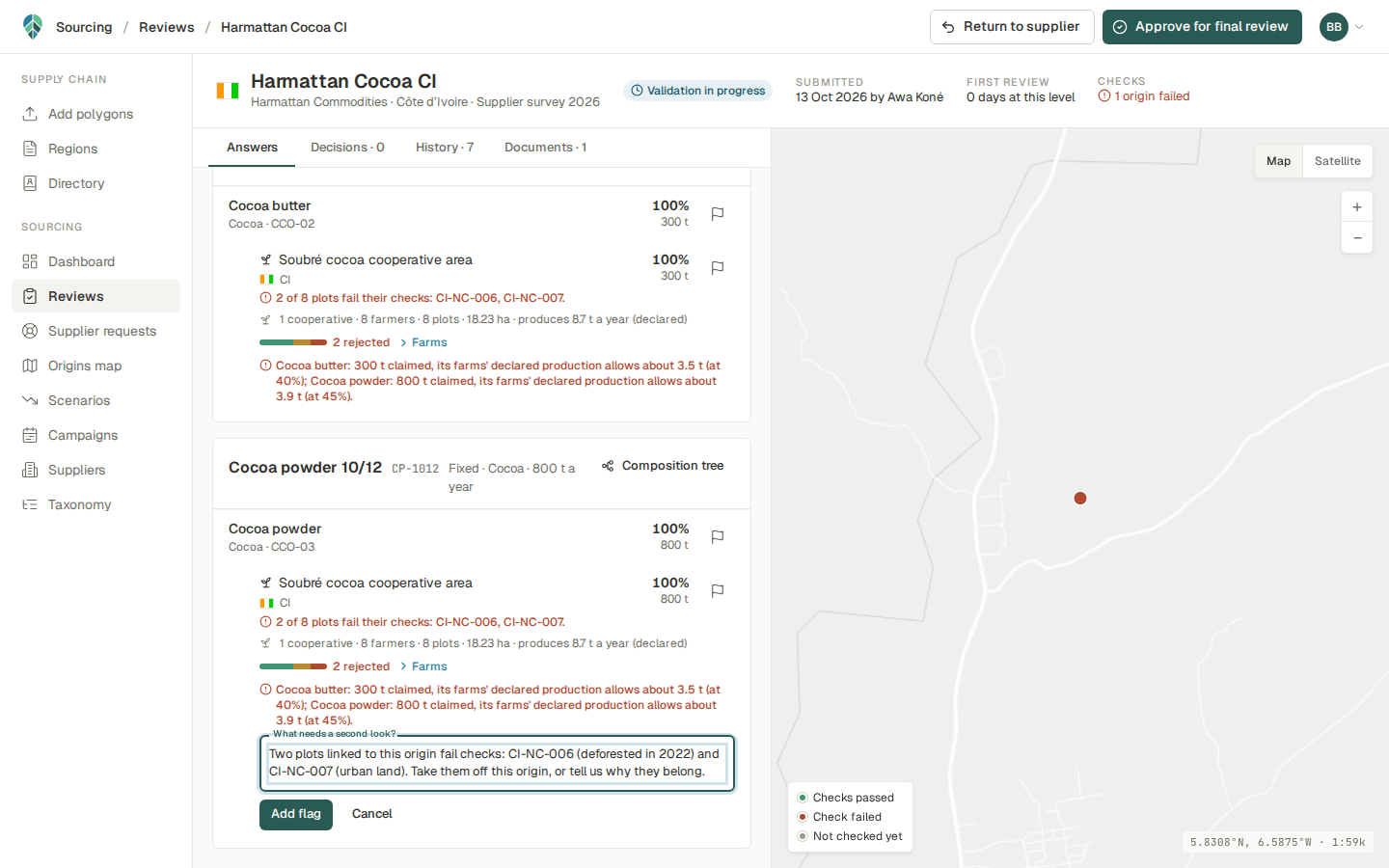
Checks flag a declared plot's characteristics for review. They don't, on their own, prove that an ingredient came from that plot.
See where your supply is exposed before disruption happens.
What happens if a country's supply stops?
What if one supplier, or a whole group, can't deliver?
How much depends on answers nobody has approved yet?
Scenarios work from what suppliers declared: the tonnes each origin supplies to each ingredient. Trying one changes nothing, so anyone with access can explore.
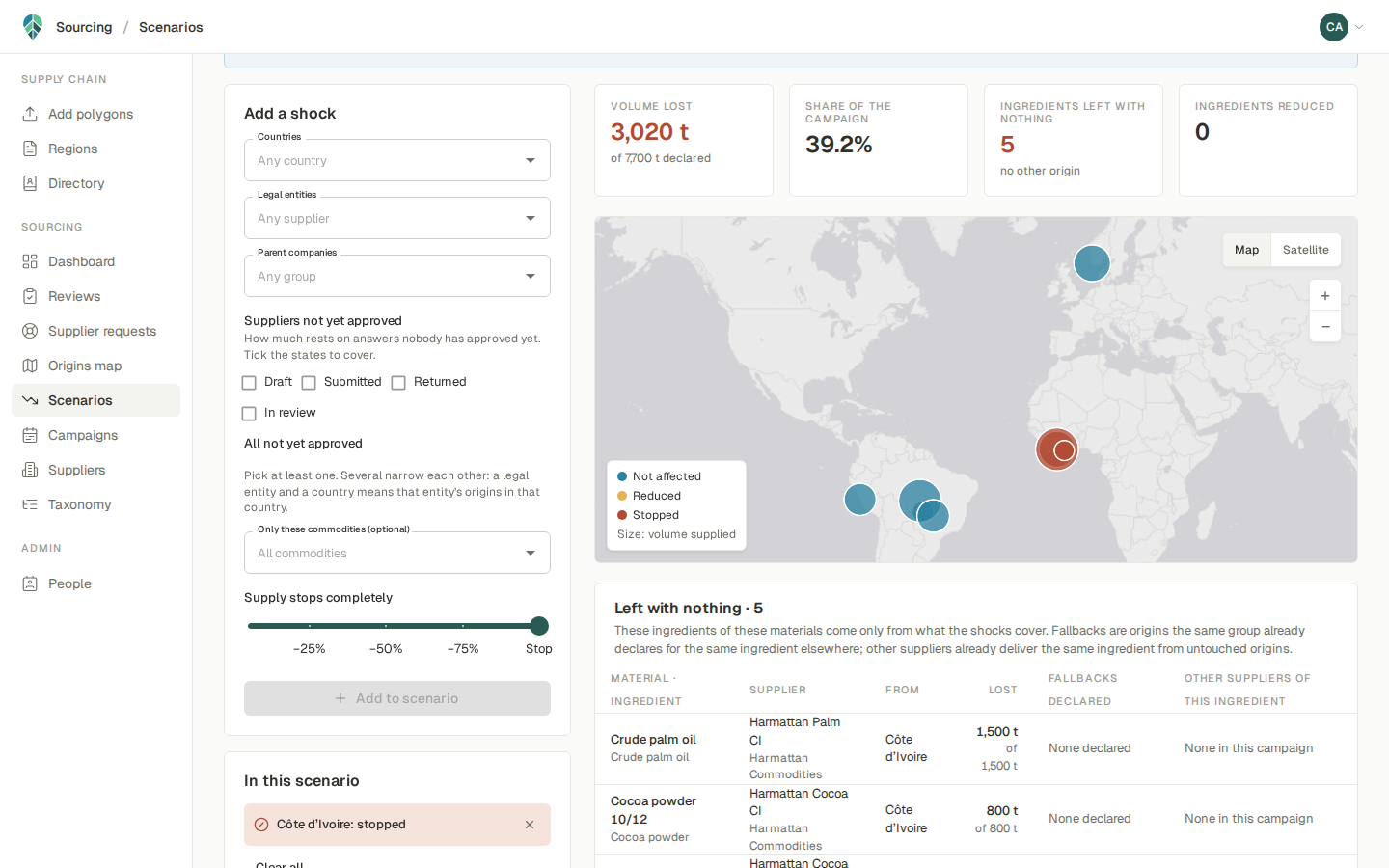
If supply from one country stops, 3,020 t of the 7,700 t declared would be exposed, and five ingredients would have no other declared origin.
Which ingredients and materials depend on one country or supplier, and how much volume is exposed.
Identify other declared origins for the same ingredient and prioritise contingency planning.
Less chasing, clearer accountability.
Explore a pilot for one priority ingredient category.
Agree the supplier scope, assess origin coverage and test the approval and exposure workflows. Measure supplier response rate, declared-origin coverage, unresolved flags and time to review.